Delivery: proof the van was there
In delivery, most time goes on two things: ringing around to find a vehicle, and arguing about whether and when someone turned up at an address. Tracking does not make the driving any faster, but it settles both arguments with a record: where the vehicle was, at what time and how long it stood there.
Free 30-day pilot on 2 vehicles · fleets of 5 or more
What actually changes
Where the vans are right now
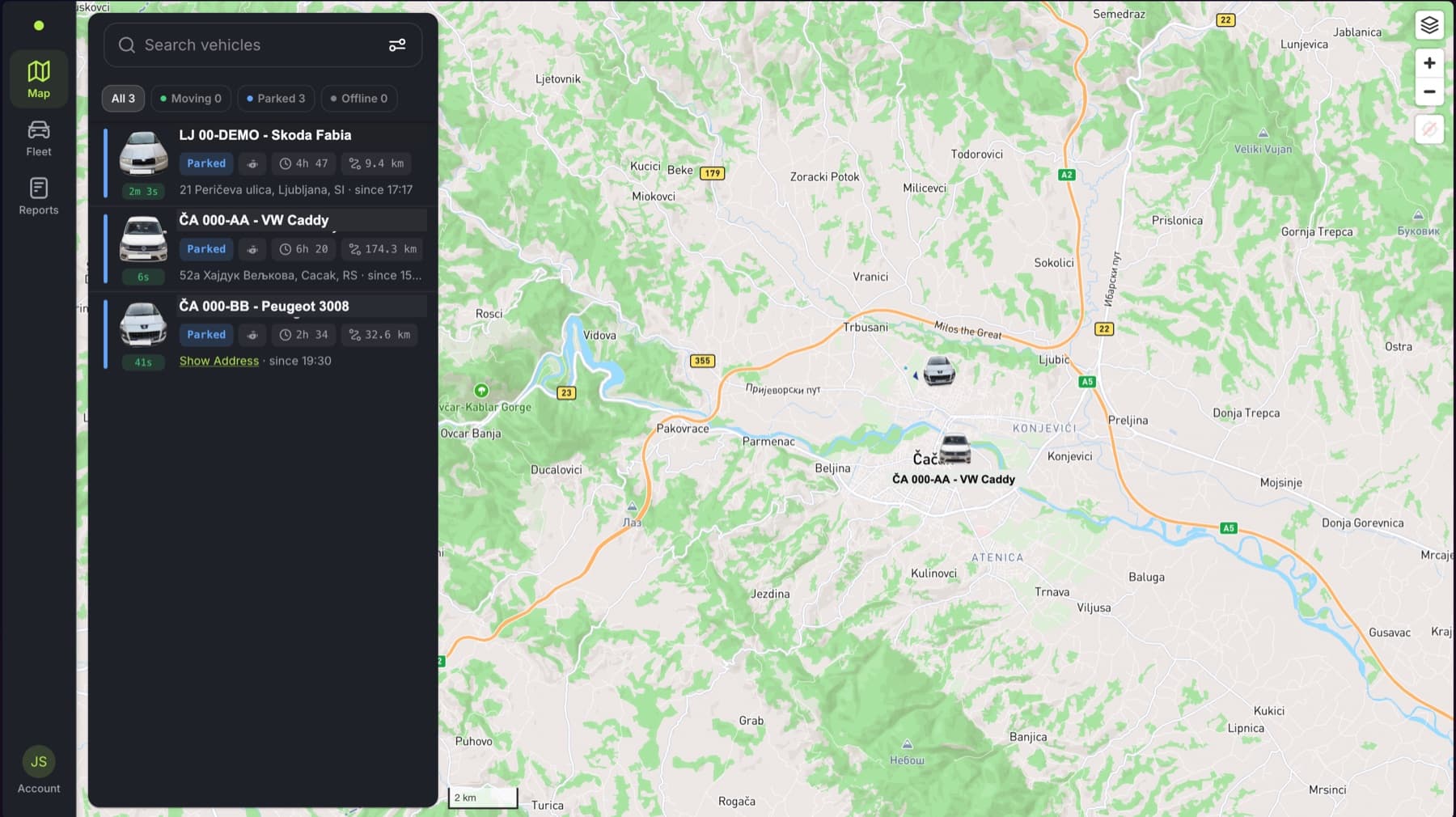
The dispatcher sees the whole fleet on one screen instead of ringing drivers to ask where they are. When a customer calls to ask where their delivery is, the answer takes a second rather than two phone calls.
That sounds minor until you count how many calls a day go on the same question. In fleets of ten to thirty vehicles it is usually the first thing dispatchers notice.
Delivery disputes
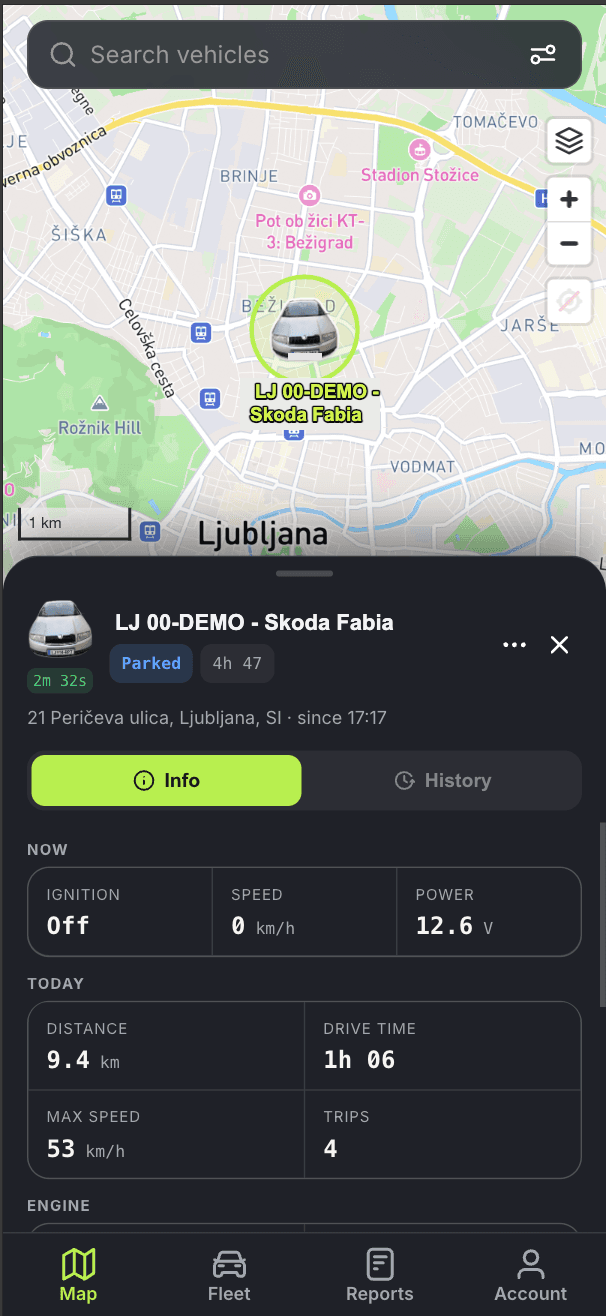
The route history records every stop with a start and end time. If you draw a zone around the customer's address, entries and exits are logged separately, so it is easy to see that the vehicle was there and how long it stayed.
That record is not legal proof in itself, but in practice it closes most disputes before they escalate, simply because both sides are looking at the same data.
Record from the demo account, 2 September 2026: one vehicle, one address.
Mileage and record-keeping
Kilometres driven per vehicle and per day are logged automatically, so records are not copied off the odometer or estimated after the fact. The gap between what was recorded and what the vehicle actually drove usually shows up in the first month.
For delivery fleets it is also the quickest way to spot private use of a vehicle, without any special surveillance of people.
Example month for one van. The figures for your own fleet come out of the pilot.
What this does not solve
Tracking does not plan routes, allocate consignments or scan parcels. If you need route optimisation with time windows, or proof of delivery with a photo and a signature, that is a different kind of software and it is only fair to say so up front.
What you get is a reliable record of movement, the foundation those things can be built on later, if you ever need them.
The same data, four angles
Dispatcher
One screen instead of a string of phone calls. Sees who is nearest, who is still at an address and who is already on the way back.
Owner
Mileage, working time and number of stops per vehicle, monthly and without spreadsheets. Patterns show over a month, not on a single trip.
Driver
Fewer “where are you now” calls. The record works both ways and most often in the driver's favour when someone complains without grounds.
Customer
A concrete answer instead of a promise: the van was at the address at 10:42 and stayed six minutes.
Questions from delivery fleets
01Do drivers have to do anything in an app?
No. The device works on its own: no logging in, no data entry, nothing to start. If you want proof of a visit with a photo or a signature, that is a separate kind of solution and it is not part of Basic.
02Can you see how long the van stood at an address?
Yes. Stops are logged with a start and end time, and if a zone is drawn around the address, entry into it and exit from it are logged separately as well.
03What if several drivers use the same vehicle?
Basic records the vehicle, not the person; shifts are reconstructed from times and ignition status. Driver identification is possible in Pro / Fleet configurations, with additional hardware and a technical check.
04Do I have to inform my drivers?
Yes. Tracking company vehicles is processing of employee data under the GDPR, and drivers must be informed before it starts. A ready-made notice template comes with the roll-out.
Try it on two delivery vans.
The pilot runs for 30 days, on two vehicles from your own fleet and at no cost while it lasts. At the end you have a record of your own deliveries, not a demo recording.
Reply within one business day
A concrete next step, not a callback request.
GDPR paperwork included
A data-processing agreement and an employee notification template (GDPR / ZZPL) come with onboarding.
No obligation
A request is not an order. You decide after you see the offer.