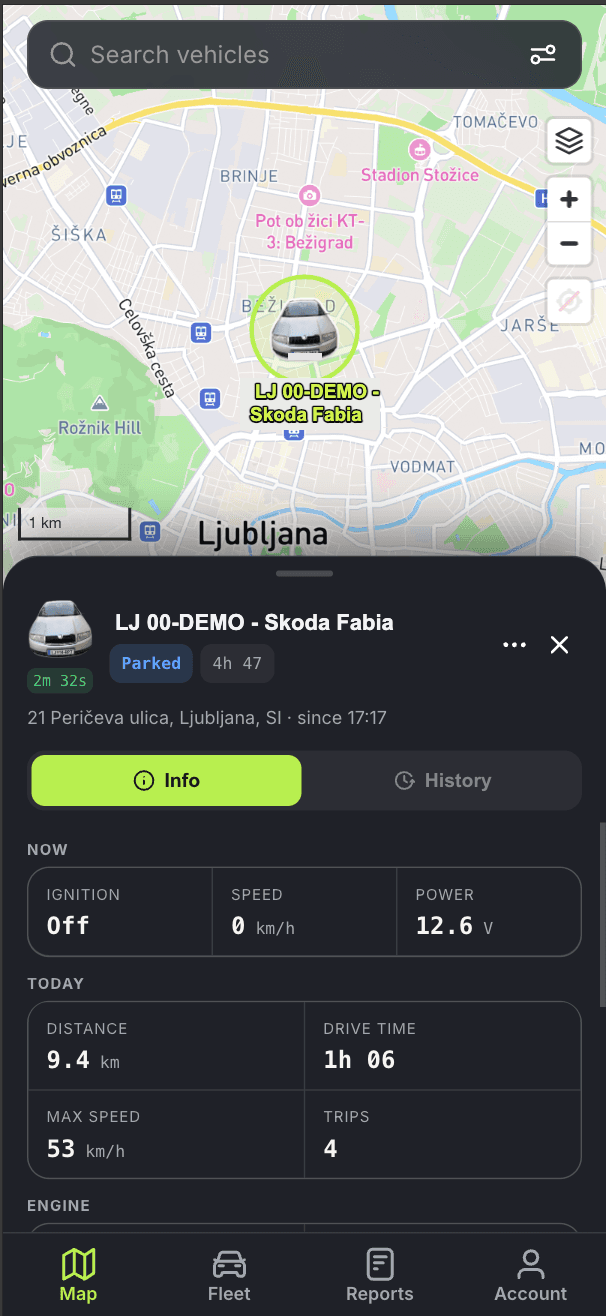
Illustrative values in the layout of the app's Engine section. Which parameters are available depends on the vehicle.
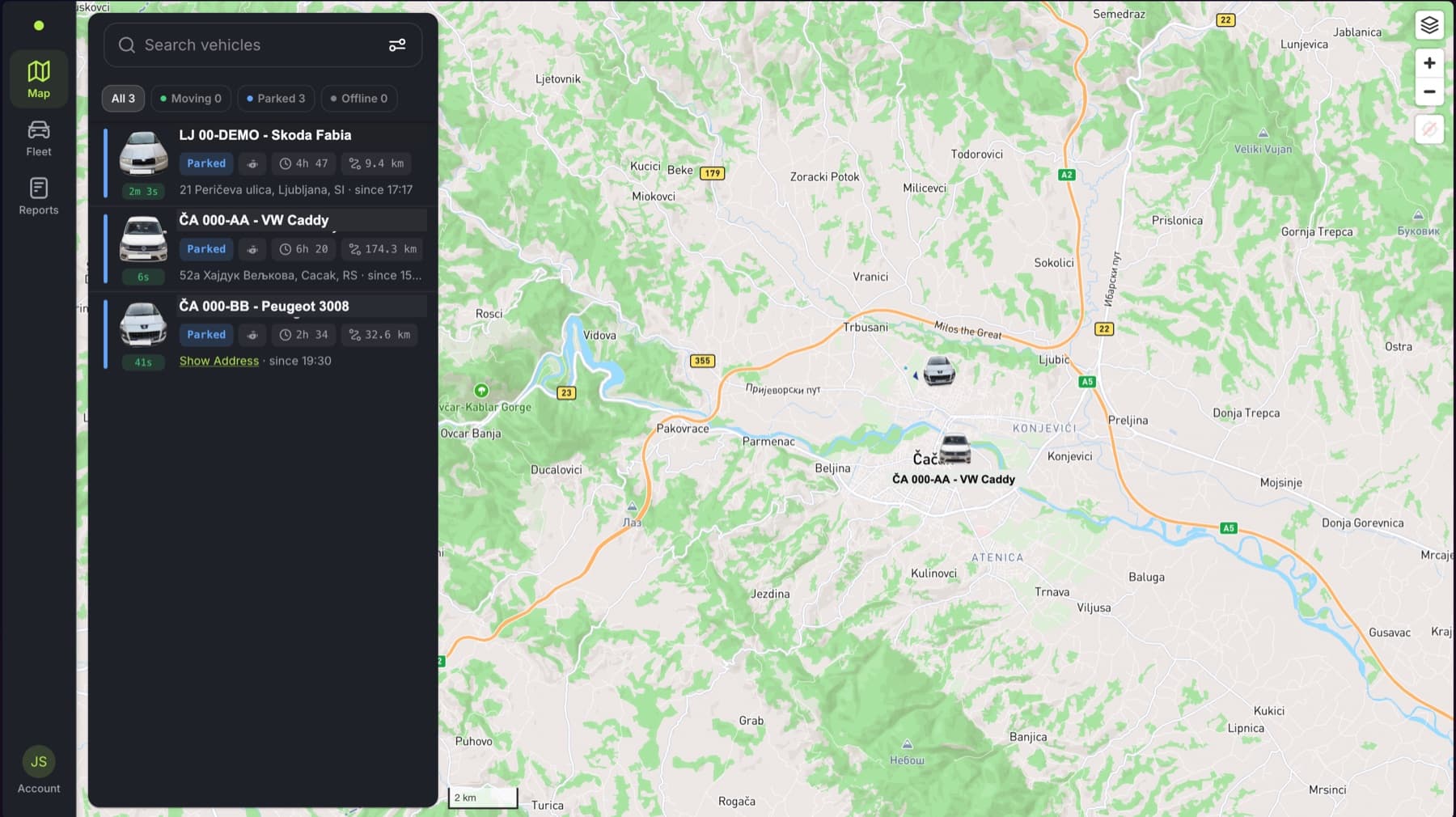
What the map can't show, the vehicle already knows.
Position and route answer where a vehicle has been. They do not answer why consumption is higher than last month, how long a machine actually worked, or when the cargo doors were opened. The vehicle sends that over its own bus, the CAN bus, and on compatible vehicles Veturo reads it alongside the GPS position.
24 parameters confirmed on our test vehicle · availability varies by model
What we have read from a vehicle so far
The list below was recorded on our own test vehicle; it is not copied from a manufacturer's catalogue. On your vehicles we confirm it in a technical check before quoting.
Driving and mileage
Speed from the CAN bus is more accurate than GPS speed, and two mileage figures (the dashboard one and the one the device counts) give a cross-check for trip records.
- Vehicle speed (from CAN)
- Dashboard mileage
- Mileage counted by the device
- Cruise control active
Engine and fuel
Working hours, revs and coolant temperature are the basis for servicing by actual use rather than by the calendar. Tank level and total fuel are counted by the vehicle itself, with no estimate from an average.
- Engine hours
- Engine RPM
- Coolant temperature
- Fuel level in the tank (%)
- Total fuel consumed (l)
Driver controls
Throttle, brake, clutch and the parking brake show how the vehicle is being handled and whether it is secured when standing.
- Throttle pedal position
- Brake pedal
- Clutch pedal
- Parking brake
Doors and cargo area
Which doors were open and when, the cargo area included: the record that settles most delivery disputes.
- Driver door
- Passenger door
- Rear left door
- Rear right door
- Rear cargo door
Seat belts and lights
Whether the belts are fastened and what the exterior lighting is doing: two states worth checking on night runs and against internal safety rules.
- Driver seat belt
- Passenger seat belt
- Dipped headlights
- Main beam
- Front fog light
- Rear fog light
The list was recorded on a single test vehicle. Whether each individual parameter is available depends on the make, model, year and configuration, which is why we check it on your vehicles before quoting, instead of promising data we cannot deliver.


Now, today, engine: on the same card
Ignition, speed and battery voltage under Now; distance, drive time, top speed and trips under Today; the readings from the vehicle under Engine. One vehicle, one card, in the office and on the phone.
Fuel that doesn't add up
Consumption reported by the vehicle itself against the fuel invoices and the kilometres driven. The gap shows up per vehicle and per period instead of being explained away by an average.
Service by actual use
Engine hours and dashboard mileage mean the service interval follows how much the vehicle worked, not how many months passed. On machines that sit on a site, that difference is large.
Cargo area and stops
Door openings with a time and a location leave a record of where and when the load was touched. That is material for claims and delivery disputes.
How the vehicle is driven
RPM, throttle and braking give a picture of driving style without a separate sensor. It is a basis for a conversation with drivers about consumption and wear, not a tool for punishing them.
Check compatibility for your own models.
Leave an email. We reply within one business day with what we need, and come back with a parameter list for your vehicles rather than a general promise.
How it is checked and switched on
A list of the vehicles
You send makes, models and years. That alone tells us what is likely to be available and what has to be checked on the spot.
The technical check
On the vehicle we check what the bus actually reports and how the device connects. The result is a parameter list for your vehicles, not a general promise.
Offer and installation
Only after the check do we price Pro / Fleet. Installation and the verification that follows it work exactly as for any other Veturo device.
Questions about vehicle data
01What is a CAN bus, exactly?
The internal network the computers in a vehicle use to exchange data: speed, RPM, fuel level, door status. The device reads that and sends it to the platform together with the GPS position, so both appear on the same screen.
02Does my vehicle support this data?
That cannot be answered reliably from a catalogue, so we check on the vehicle itself. Newer delivery and freight vehicles usually report the most; on older vehicles and on machines the set is narrower.
03Is this included in Basic?
No. Basic is GPS tracking, which works on any vehicle regardless of model. Vehicle data is part of Pro / Fleet, which is quoted individually precisely because it depends on the vehicle.
04What does it cost?
Pro / Fleet is quoted individually, depending on the device, the vehicle and which parameters are available on it. The price of Basic and of the device is published on the pricing page.
05What if the vehicle reports only some parameters?
Then you get those, and we tell you beforehand. It is better to know before installation that fuel level is not available on that model than after it.
06Does more data change my obligations towards employees?
Tracking processes employee data regardless of how many parameters you read, so the legal basis and the duty to inform stay the same. But the more you collect, the more it matters that the purpose is clearly defined and that you are not collecting what the purpose does not need.
Find out what your vehicles report.
In the pilot we fit two devices and check on your own vehicles which parameters are actually available. The result is a concrete list for your fleet, not a promise from a catalogue.
Reply within one business day
A concrete next step, not a callback request.
GDPR paperwork included
A data-processing agreement and an employee notification template (GDPR / ZZPL) come with onboarding.
No obligation
A request is not an order. You decide after you see the offer.