Taxi: a record that does not rely on memory
Taxi fleets already have a dispatch system and a taximeter. What is usually missing is a clean record of the vehicle itself: how long it was in service, how far it drove and which route it took when a passenger makes a complaint. Tracking covers that part and stays out of the rest.
Free 30-day pilot on 2 vehicles · fleets of 5 or more
Where tracking helps
Shifts and time in service
From running time and ignition status you can reconstruct how long the vehicle was in service, when it started and when it stopped. For fleets with several drivers per vehicle it is the quickest way to compare the shift plan with what actually happened.
The device records the vehicle, not the person. Driver identification is possible in Pro / Fleet configurations, with additional hardware and a check; it is not included in Basic.
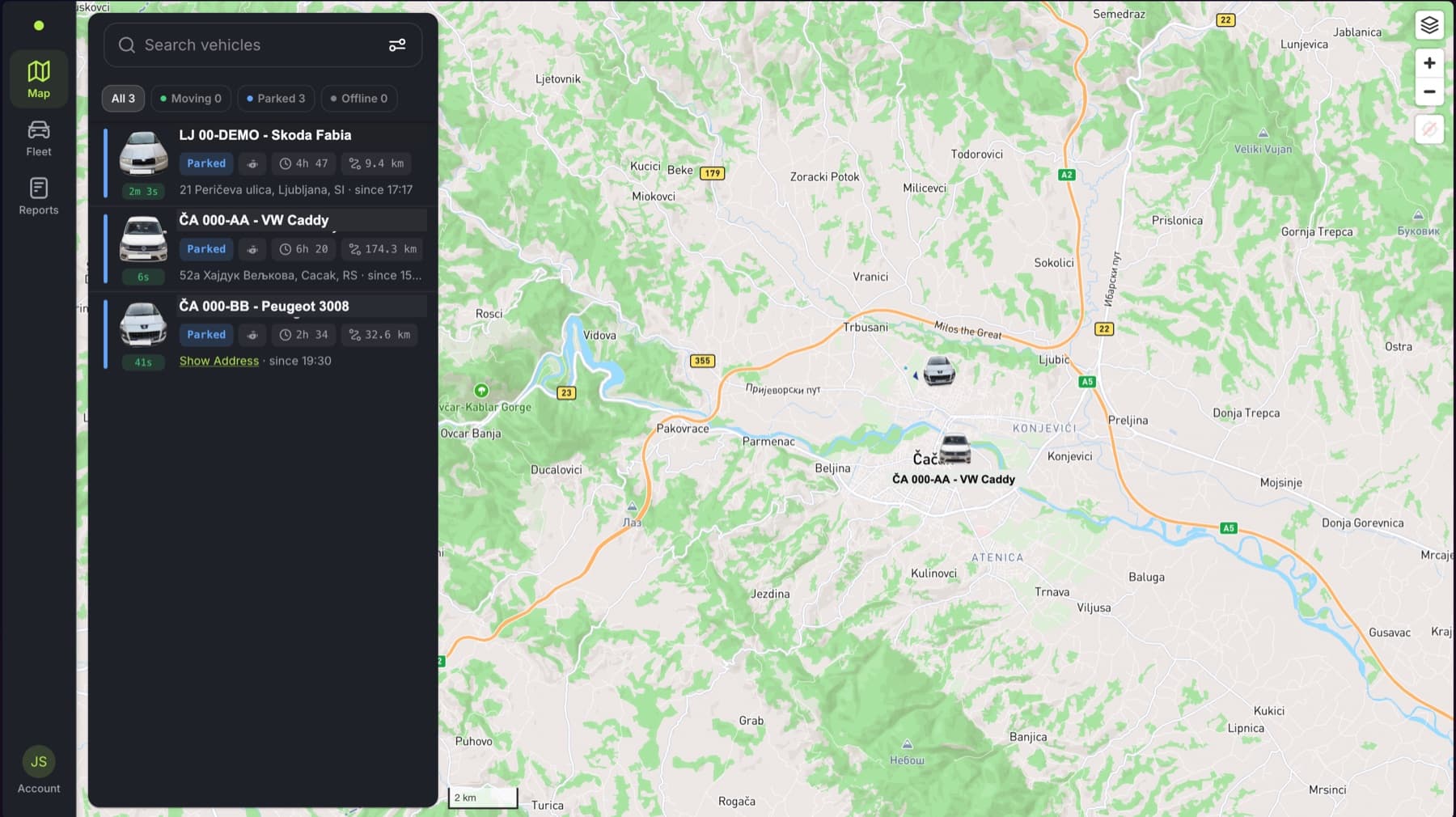
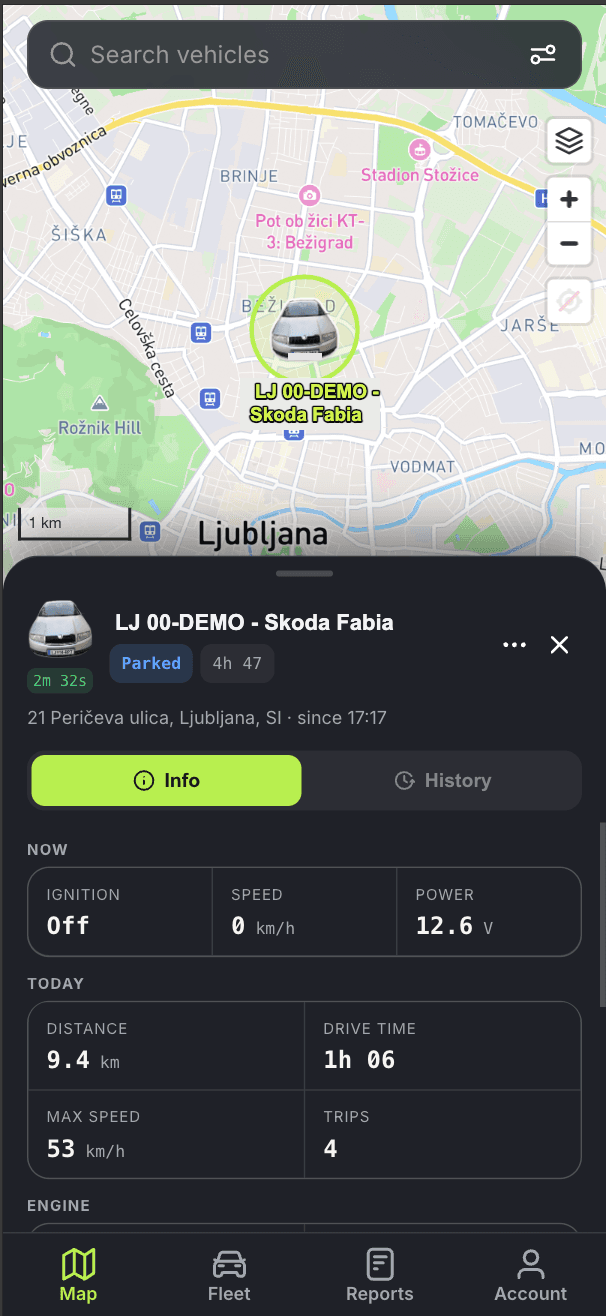
Example day for one car. The shift is read from running time, not from a driver login.
Passenger complaints
When a passenger reports that a journey took a roundabout route or that the car never came, the route history with its times usually closes the argument in a couple of minutes. It works both ways and most often in the driver's favour.
Position is accurate to within a few metres in the open, and in narrow streets between buildings it can drift, which is why a route is read as a whole, not as proof of an exact point on the pavement.
Mileage and maintenance
Taxis cover high mileage in a short time, so service intervals come round faster than expected. Automatic mileage records per vehicle make it easier to plan servicing and to compare costs between vehicles in the fleet.
On compatible vehicles engine running hours can be read as well, which describes the real load on a vehicle better than mileage alone.
What this is not
Tracking is not a taximeter, it does not calculate fares, it does not issue receipts and it does not connect to ride-hailing apps. It does not replace the dispatch system you already use.
That is deliberate: we do one thing, a reliable record of the vehicle, and we do not pretend to cover the rest of the job.
What you get, and what stays with you
A record of the vehicle
Time in service, kilometres driven, routes and stops, per vehicle and per day, with no manual entry.
Material for complaints
Route history with times, available when you need it, not reconstructed from memory a week later.
Your duty to drivers
Drivers must be informed before tracking starts. A notice template comes with the roll-out.
What stays with you
The taximeter, fare calculation, dispatch software and the relationship with passengers. Tracking does not interfere with any of it.
Questions from taxi fleets
01Does this replace a dispatch system?
No. Tracking gives a record of the vehicle: position, routes, running time and mileage. Taking bookings, allocating jobs and calculating fares stay in the system you already use.
02Can you see which driver was on shift?
Not on Basic, because the device records the vehicle. The shift is reconstructed from running times. Driver identification is possible in Pro / Fleet configurations, with additional hardware and a technical check.
03Does tracking slow the vehicle down or get in the driver's way?
No. The device is fitted out of sight, works on its own and asks nothing of the driver: no logging in, no data entry, no app to start.
04Do drivers have to be informed?
Yes. Tracking company vehicles is processing of employee data under the GDPR, and the notice has to go out before the first journey. A ready-made template comes with the roll-out.
Try it on two vehicles from a shift.
The pilot runs for 30 days and is free for qualifying fleets of at least 5 vehicles. At the end you have a record of your own fleet and a concrete quote.
Reply within one business day
A concrete next step, not a callback request.
GDPR paperwork included
A data-processing agreement and an employee notification template (GDPR / ZZPL) come with onboarding.
No obligation
A request is not an order. You decide after you see the offer.